
In 2019, going to the office was just what most people did: cheap meal deals for lunch, a predictable commute, a coffee on the way into the office.
No one questioned it.
But in 2025, things are very different and whether employees, office gurus, or boards like it or not – people are questioning when, and why, they need to be in the office.
Sure – there is real value to being in a room with colleagues for key meetings and to talk, but we’ve proven we can work productively from anywhere. Some want to be in the office every day - and that’s fine.
For many though - the cost, the time, and the lifestyle trade-offs make returning an unpalatable choice - especially when they believe hybrid productivity has already been proven.
Just what are those costs?
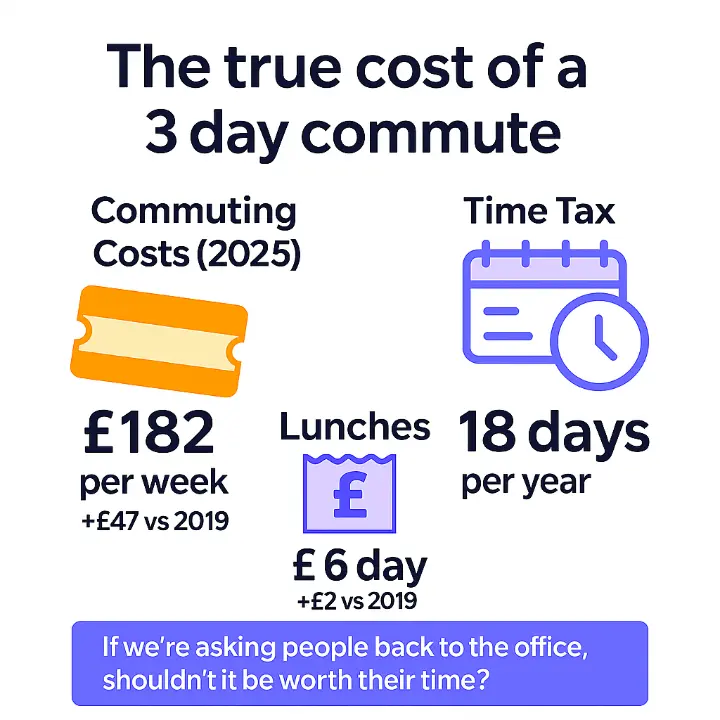
🕒It isn't just money - it's time
🕒. That's 18 days per year spent commuting. Time not being spent on yourself.
With a highly varied workforce made up of multiple generations and demands – getting your strategy right is important.
People are noticing your office policy - whether you notice (or care) or not.
So what’s driving the disconnect, and why the resentment of the returning to the old ways?
🏢The Boardroom Narrative vs. Demands of a Mixed Generational Workforce 👩💼🧑🏻💼🙋♀️
Many leaders want people back in the office because "It’s better for collaboration”...or because they don't trust remote work.
But what about our mixed generational workforce? What do people want and what is their attitude to where they should be working?
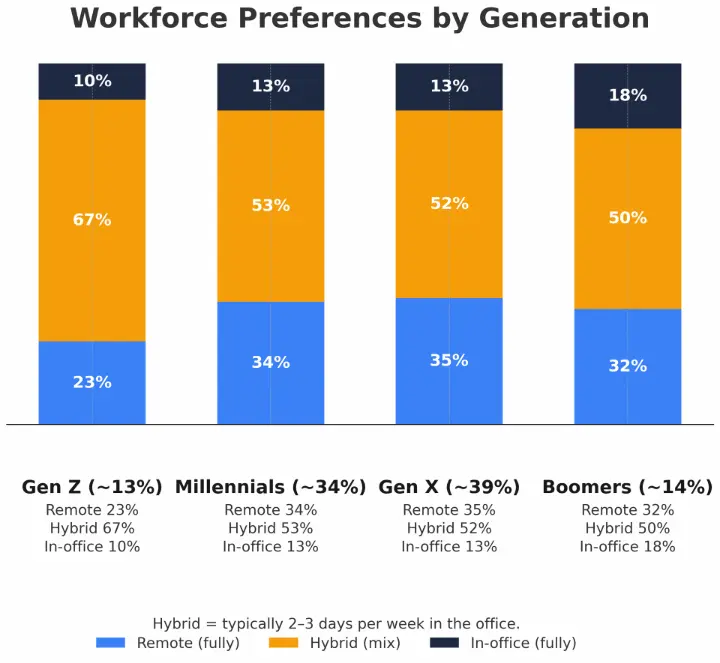
Few want to be in the office full time. Contrary to what some may have thought though - fully remote work is least popular amongst the youngest members of the workforce. This shouldn't be a surprise though - these are often the people most in need of support and learning in the workplace, and who perhaps may not have the ideal remote work setups.
❌It's clear though - full time return to office is not popular.❌
People who have been working largely remotely or in the office only a day or two per week don’t see “collaboration” as sufficient reasoning to increase time in the office, their experience is something else entirely. They view hybrid or remote work as being proven. And it's complex - because the workforce is made up of multiple generations with different wants and needs.
Going back to the office, they’re being asked to contend with:
🕰️Loss of Time: Commuting eats 2-4 extra hours a day, erasing evenings, meaning missed school pickups, less life.
💰Increased Expenditure: The same 3-day office week that might have cost ~£5,675/year in 2019 now costs ~£7,865/year - a 38% increase!
🧘♂️Wellbeing and balance: Less time for family, hobbies, and decompression. “Working hours” don’t decrease – but now your personal time is being used for “work” commuting.
All to often the office experience you've given up all this for involves...
👩🏻💻Sitting on video calls with...people who aren't in the office
🥊Fighting for call booths that are always occupied
🕵️♀️Discovering half your team isn’t even in that day – which leads to more video calls
The value exchange that being in the office is supposed to provide has, for many, eroded, and both employers and employees know it.
It's hard for leaders and workplace planners though! Different generations demand different things from the workplace, need different support structures and have different social expectations...but with a workforce this mixed - it's not surprising getting it right is hard!
🏢💵🔙The Real Cost of Going Back
The resistance isn't just "I don't want to be in the office or commute". The cost of commuting isn’t just time, and it isn’t just the cost of a train fare – although transit costs have definitely increased.
It’s parking. It’s lunch. It’s your morning coffee. It’s all got noticeably more expensive.
Commuting, Parking & Lunch Inflation (2019 → 2025):
Cost Element | 2019 (3 days/week) | 2025 (3 days/week) | Increase |
🚅Train fares (~£29/day → £40/day) | £4,350 | £6,000 | +£1,650 |
🅿️Parking (£6 → £9/day) | £850 | £1,300 | +£450 |
🥗Lunches (£4 → £6 avg) | £576 | £864 | +£288 |
Total annual cost | ~£5,776 | ~£8,164 | +£2,388 ⬆️⬆️⬆️ |
3️⃣🗓️The cost of going to office 3 days/week? 3️⃣🗓️
It could be up to £8,000 per annum!
It’s no surprise people are pushing back – that's from net pay. It’s a huge amount – especially for those who have become accustomed to not paying it. It’s the equivalent to a luxury two-week family holiday in peak holiday season - or half a year’s groceries for a family of 4.
The Collaboration Myth (and the 🧟Zombie Meeting Problem)
Collaboration is the most cited reason for RTO mandates. There is an idea that being in the office automatically means collaboration, that without any effort people will suddenly be "collaborating" by being in the same space.
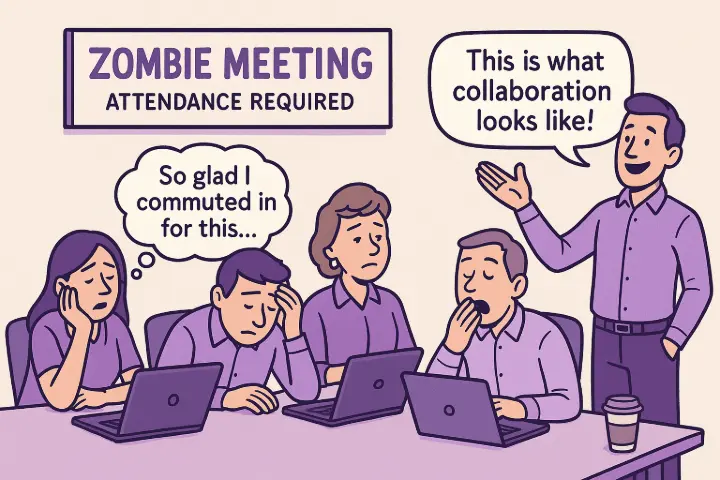
Here’s the reality though for too many:
🚫 35% of meetings are considered wasteful and unnecessary
🥀Up to 46% of meeting time is rated unnecessary or unproductive - that’s 146 hours/year per employee(!)
😵💫72% of professionals report meeting fatigue.
This is where employee frustration really builds: “collaboration” becomes a catch-all excuse to enforce attendance, but office time isn’t being designed for meaningful collaboration.
And while hybrid calls work when well planned, unstructured “zombie meetings” leave everyone disengaged - fueling the pushback against being forced in. No one wants to be in the office for a “should have been an email” meeting.
🕒🧾The Time Tax Nobody Talks About 🕒🧾
A 90-minute commute one way is 9 hours/week lost on a 3-day schedule - equivalent to a full working day wasted weekly. That’s 12 working weeks yearly that you’re asking people to spend commuting! It better be worthwhile!
It’s no surprise that in 2025, many knowledge workers say:
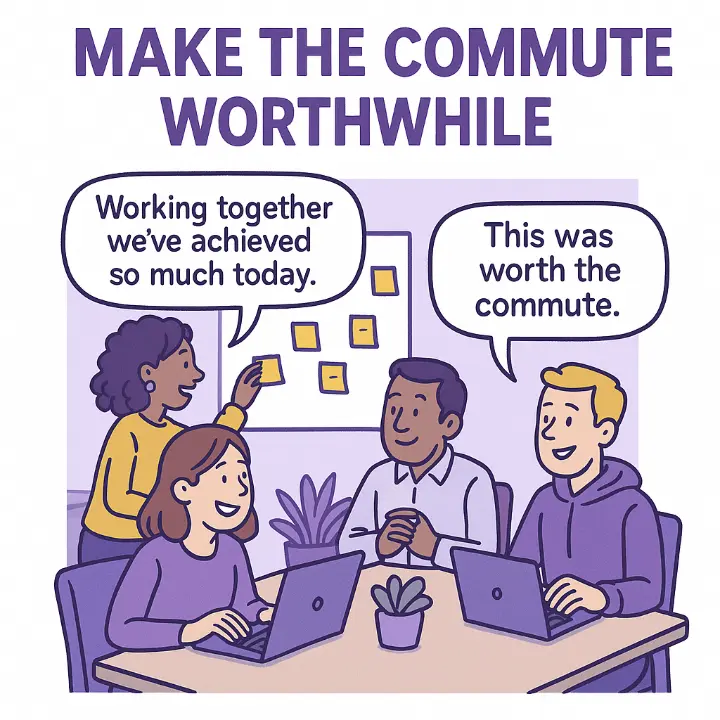
People want to come to the office to see people - and do things that you can't do as easily remotely...not just to sit on calls and it meetings that could have been an email.
Measure the impact of these meetings - in output, happiness, motivation, retention.
Fortune’s Best Companies to Work For report (May 2025) shows:
🚀Companies recognised for flexibility and wellbeing report ~42% higher productivity than the U.S. average.
💚81% of employees in those firms describe their workplaces as psychologically healthy, compared to just 45% in typical environments.
(greatplacetowork.com, 2025)
🎯✍Workplace Design: Why We Keep Missing the Mark
So what about the office? Organisations are pouring millions into office redesigns and collaboration zones, often canvassing for both expert and employee opinions - but still employees are still asking:
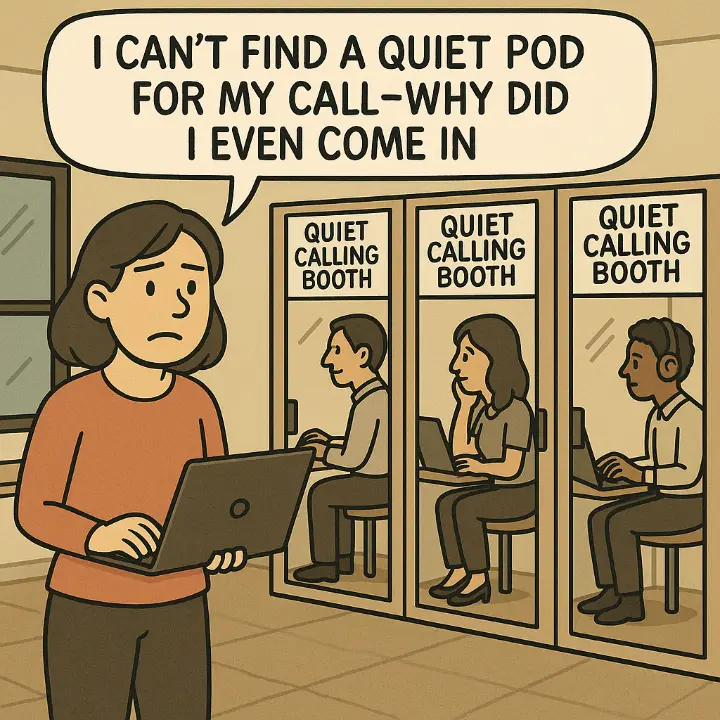
Why is this happening if we've asked people how we should design the office?
Employee surveys often ask what people think they want - not what they actually need.
People answer aspirationally, not practically: “Yes, I’ll use more open collaboration space,” but then they spend 80% of their day on focused solo work.
🛠️The fix: Don't just listen to surveys or what you think people want – look at the spaces that are actually used and find out what people find useful in the office, and match this to the reasons that people should be in the office.
Which spaces get booked most? - do we know why?
When are floors busy or empty? - do we know why?
Where does overlap naturally occur?
- What is making people feel being in the office is worthwhile - how can office design be matched to this?
This isn’t about tracking individuals. People won’t tolerate “Big Brother” surveillance, and in many markets, it isn’t even legal.
It's important that people come to the office for the right reasons...not just to sit on calls! That is not collaboration. And office design has to deliver the spaces people want to make their time worthwhile.
🛢️📊⛽Data is the new oil...apparently!🛢️📊⛽
That being said – good luck with just looking at raw data to make decisions!
What space are being used right now? Important - but doesn't have context.
Looking at survey results? Good luck decoding what's real and honest, and what's based on current situation or expectation.
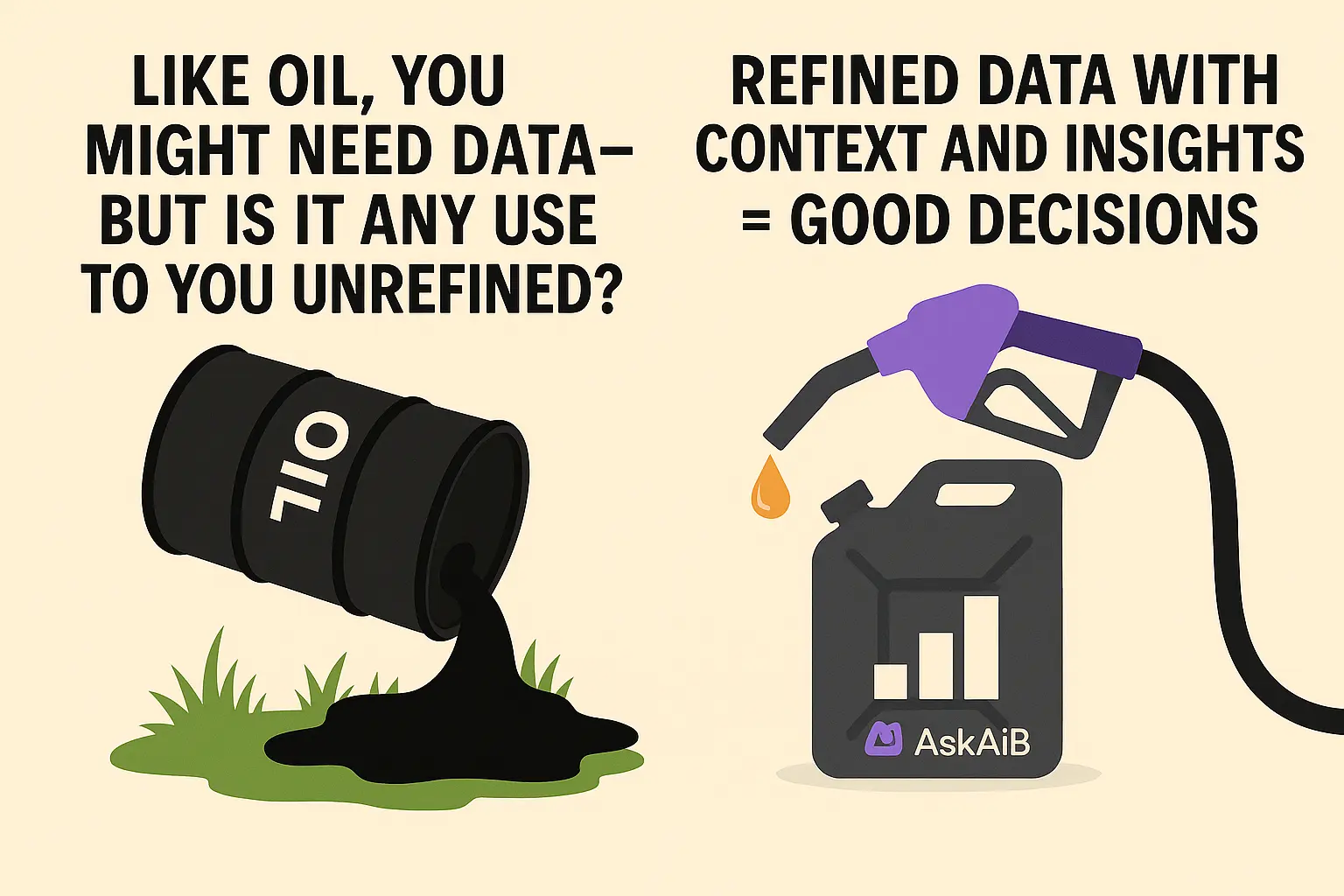
Data may be the new oil – but like oil, it’s useless unless refined into something useful.
I mean, despite its vital importance in your life (our shoes, glasses, toys etc - all made of oil!) – if I dumped a barrel of oil onto your front lawn, what use would it be to you?
It needs to be refined to be useful.
Raw, unrefined and unfiltered data = oil dumped on your lawn.
Refined, anonymised data with context and insights = fuel for good decisions. And this is what you need for office space and policy planning.
When you know how space is actually used, you can design policies and layouts that work for real people, not just survey responses. That's essential for provisioning both the workplace policies and the physical space that will make visits to the office fulfilling, not frustrating.
🔀🏆Talent, Retention & Flexibility 🔀🏆
In 2025, we’re a long way from the “Great Resignation” of 2021-2022. Back then, employee turnover had been at historic lows during the pandemic and it was followed by an explosion of job-switching when economies reopened.
Now, the pendulum has swung the other way:
It’s an employer-driven market.
Money isn’t cheap anymore.
Competition for roles is fierce, with dozens or even hundreds of applicants for top positions.
But markets and dynamics always shift. And when it swings back to an applicant-driven market - and it will - the winners will be the companies that got ahead of the curve:
Who attracts talent when workers have choices?
The stale, 5-days-in-office mandates
Or the firms that trust people to work where and how they’re most effective?
This isn’t just about “being nice” to employees. It’s about building long-term resilience in talent strategy. It’s about making your office attendance strategy based on outcomes – not just bums on seats.
📐🔑Measuring What Matters 📐🔑
In 2025, many companies haven't adapted to tracking what really matters and instead still track:
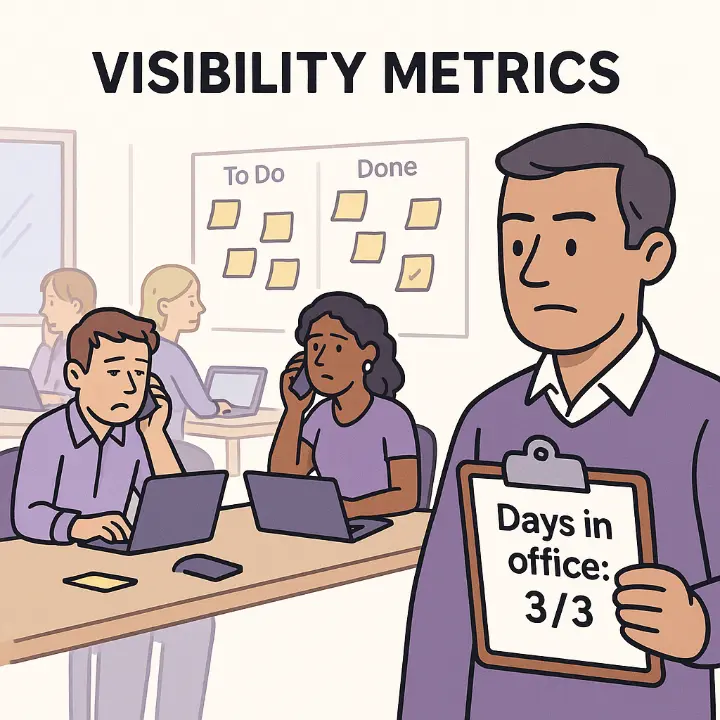
How many times you are in the office
“Compliance” with policies.
But these are visibility metrics, not value metrics.
We should be measuring:
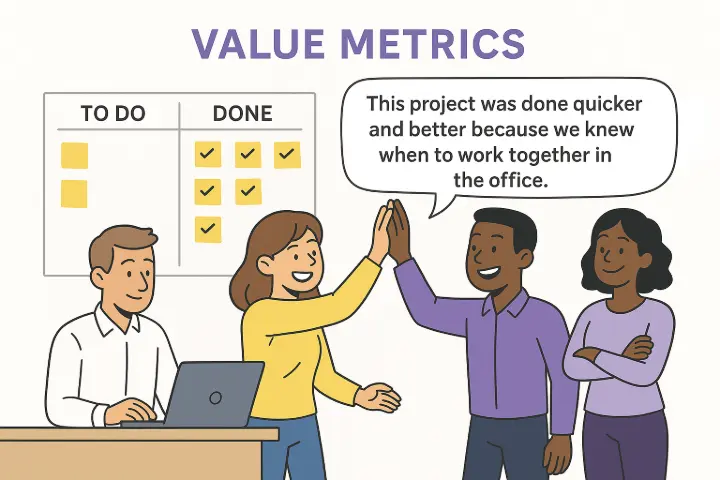
Outcomes: Are projects moving faster?
Happiness & wellbeing: Do people want to stay and are they happy at work?
Retention & attraction: Are we losing or winning the talent battle?
Companies that measure presence will lose to those measuring performance. Your office strategy needs to be matched to positive outcomes. The office needs to boost productivity – not drain people with 9 hours of commuting to sit on video calls that could be done from anywhere.
The Importance of Getting it Right
In 2019, the office was for many, the default. Sure, some forward looking organisations were already implementing or experimenting with hybrid, but office was the norm.
In 2025, with:
30%+ higher commuting costs
19% pricier lunches, and
A workforce that has proven remote productivity...
…it’s no longer enough to mandate attendance, not if you want a happy and productive workfroce.
If you want people back, make it worth the commute - purposeful, planned, transparent, and flexible.
Because collaboration isn’t a buzzword. It’s a choice. And the policies you set today will decide who wins tomorrow.
You need systems and measures in place to make sure people are coming to the office for the right reasons - and they know it's worthwhile.
We'd love to hear from you - contact us to discuss anything in the above, how we can help with making hybrid work work or to see our platform in a live demo!