
Return to Office Planning: Why Accurate Office Utilisation Data Is Now Critical to Workplace Optimisation
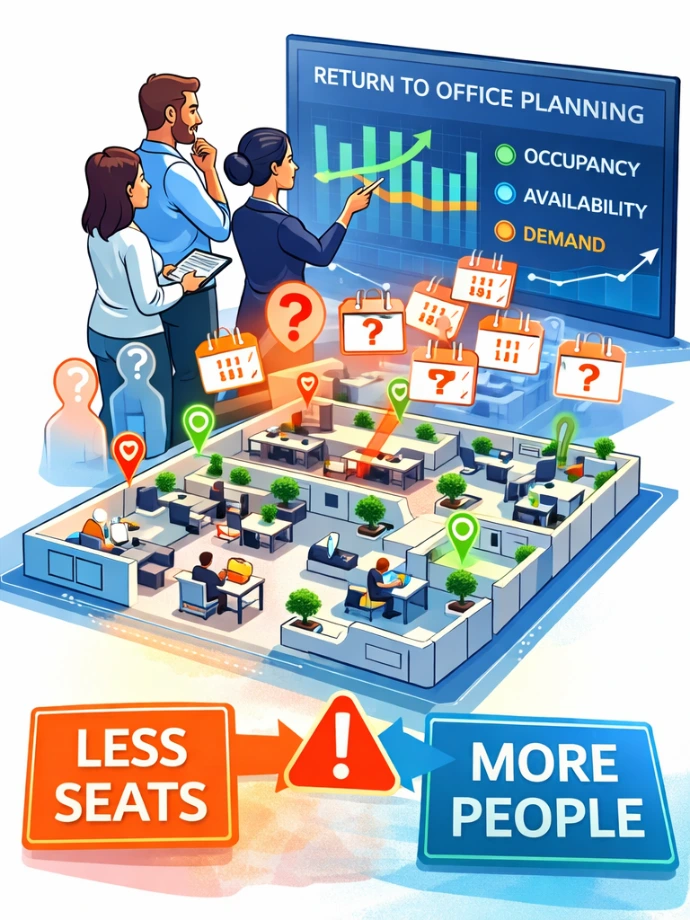
Return to office planning is back at the centre of organisational strategy.
Policies are being set. Attendance expectations are changing. Teams are being encouraged - or required - to spend more time in the office.
But once direction is set at leadership level, the responsibility for making it work shifts elsewhere.
It shifts to facilities, workplace and estate teams. These are the people who were asked to shrink footprints, and are now being asked to make provision for all those returning to the office.
And at the heart of that challenge sits one critical factor:
Reliable office utilisation data.
The Operational Reality of Return to Office Planning
Return to office planning is not simply about culture or policy.
It is about operational delivery.
Many organisations have already reduced their footprint over the past few years. Hybrid models led to consolidation, flexible seating and shared desks.
Now workplace teams are being asked to:
Support increased attendance without expanding space
Maintain user experience while controlling cost
Enable collaboration through effective desk management
Provide accurate utilisation reporting
Optimise office space based on real usage patterns
That is a workplace optimisation challenge.
And it depends entirely on the quality of the data underpinning space planning decisions.
When Office Utilisation Data Does Not Reflect Reality
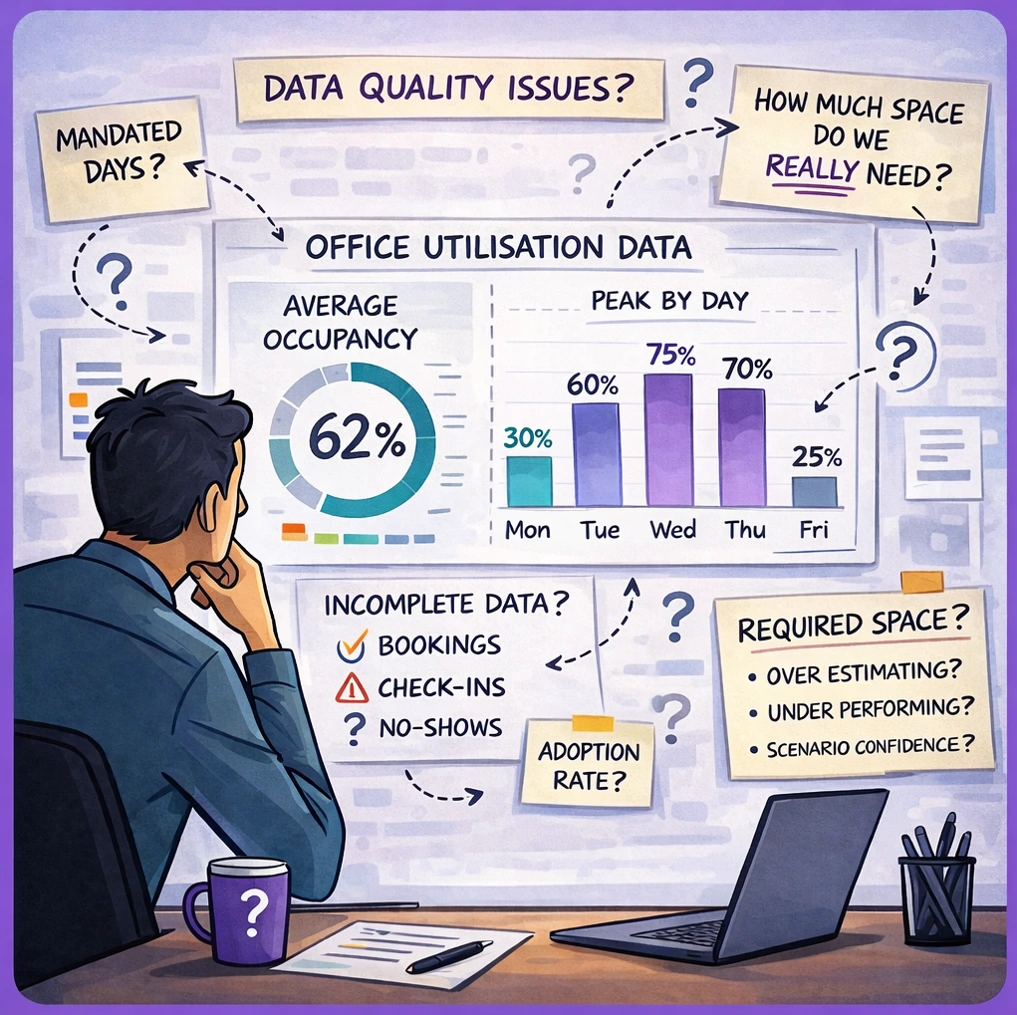
On paper, dashboards often look clear.
Occupancy rates.
Peak days.
Average team attendance.
Meeting room usage.
But return to office planning exposes weaknesses in many existing data models.
The office may feel busier...or quieter than the utilisation report suggests.
Days may be more concentrated than averages reveal – the TWT phenomenon.
Spaces are booked or look busy...but you walk past – and there’s no one there.
So the important questions emerge:
Is the data based just on desk bookings - or actual presence?
Are check-ins consistent across departments?
Are no-shows because people forget to check-in – or are they really not there?
Is desk management software being used consistently?
Do people just...forget to use the system?
Inaccurate office utilisation data creates risk.
Overestimate demand and office space optimisation stalls because consolidation feels unsafe.
Underestimate demand and peak-day friction damages employee experience.
When confidence in the data drops, decision-making slows.
The Cost of Getting Workplace Space Planning Wrong
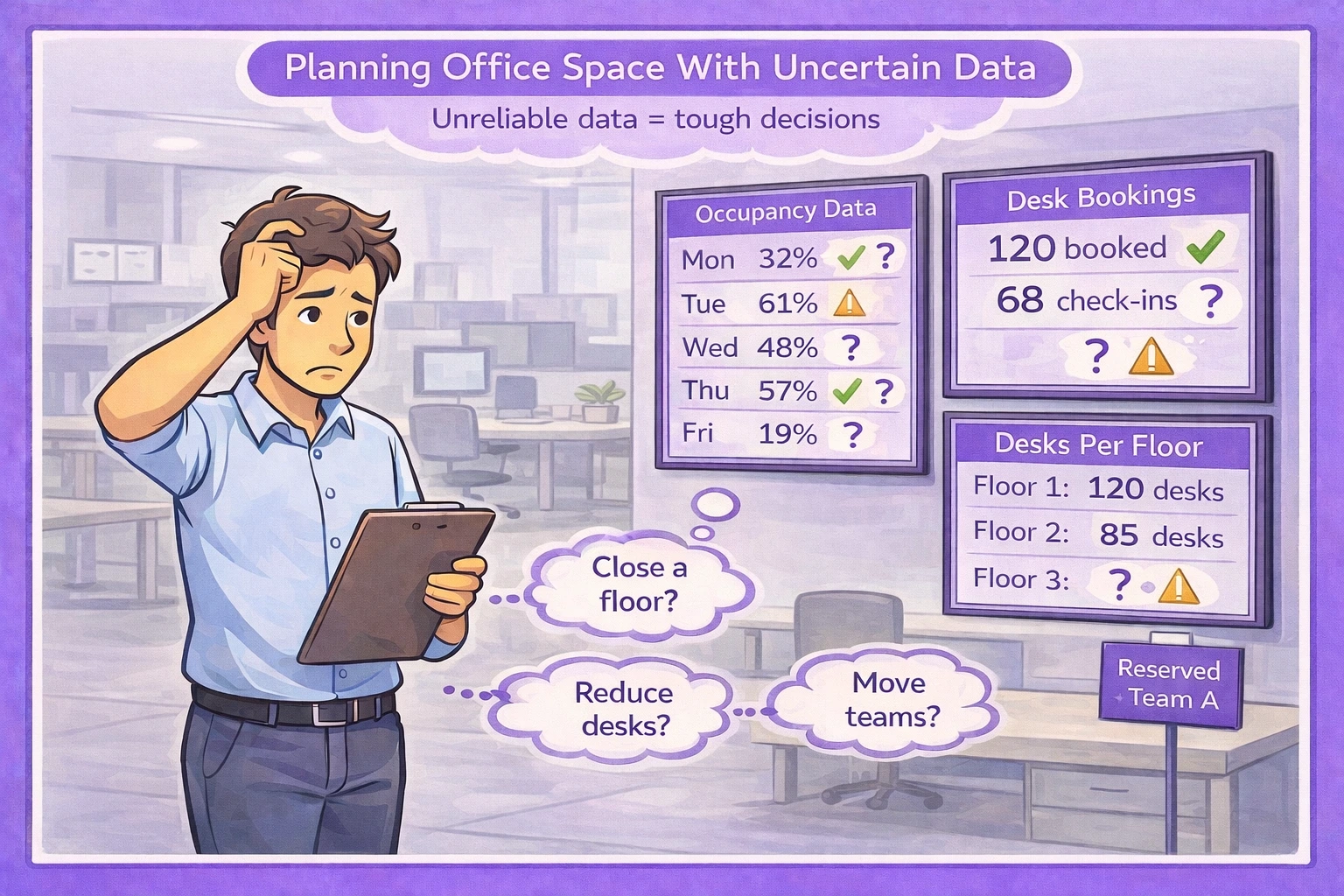
Workplace planning mistakes are expensive to reverse.
Closing floors.
Reducing desks.
Reallocating teams.
Renegotiating leases.
If office utilisation data is unreliable, office space allocation planning becomes reactive rather than strategic.
Facilities teams are forced to retain space “just in case.”
Desk management strategies remain conservat ive.
Cost savings are delayed.
And the opportunity to genuinely optimise office space is lost.
The issue is rarely a lack of reporting tools.
It is a lack of confidence in how the data is captured.
Why Desk Management and Data Capture Needs To Change
Traditional approaches to desk management and office utilisation tracking often rely on:
Manual desk booking and check-ins
Behaviour-driven compliance
Hardware-heavy sensor installations
Complex integrations between booking platforms and access control systems
These approaches can increase cost and complexity, sometimes stretching deployment into months or even years - without necessarily improving data accuracy.
The key to effective workplace optimisation is not more reports.
It is more reliable, more straightfroward data capture.
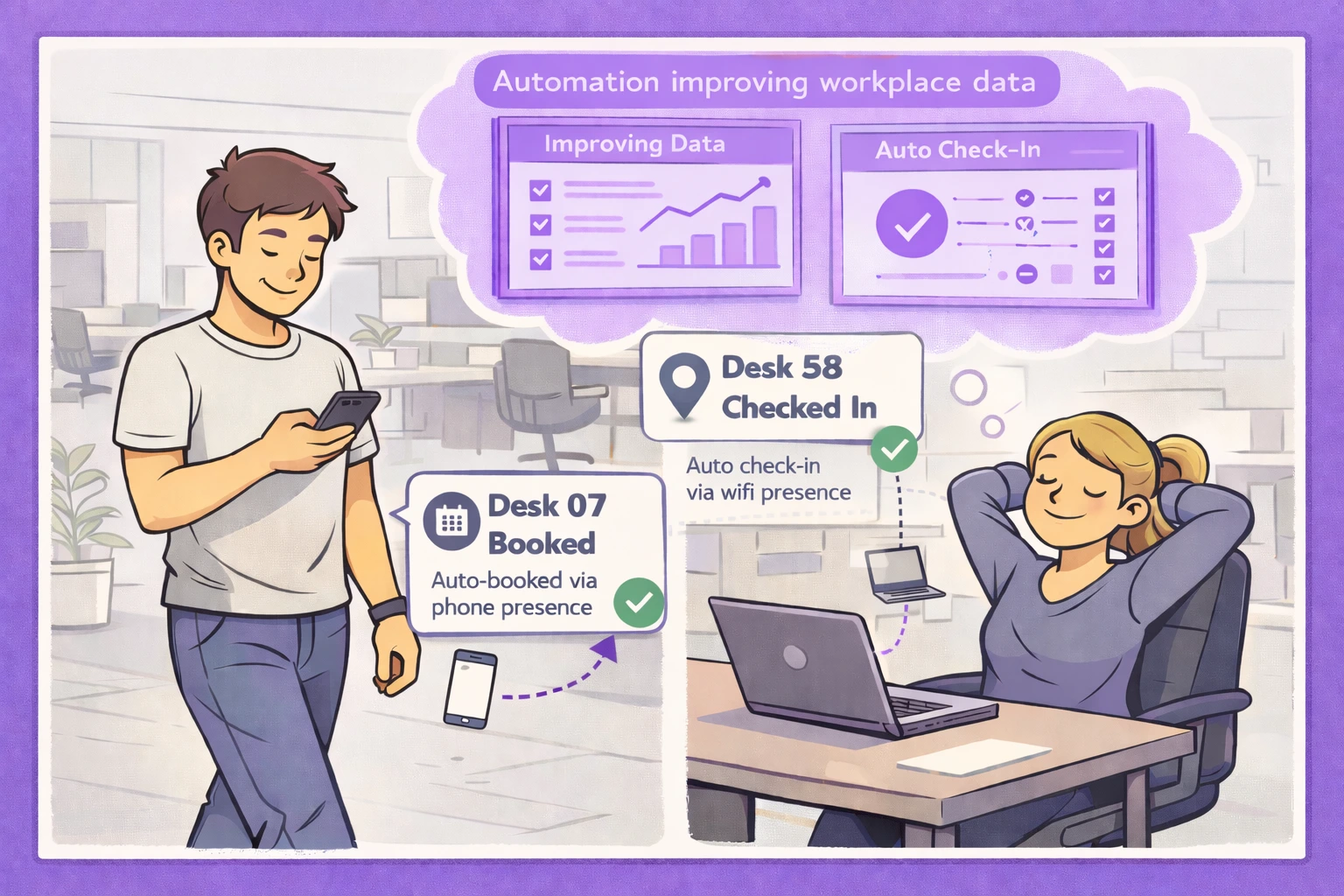
Most employees already carry a device that makes this possible.
- A mobile phone.
- A laptop.
They connect to office WiFi.
They use Microsoft Teams.
They move through shared spaces.
Presence-based automation allows organisations to use this existing digital footprint to improve office utilisation data accuracy - without increasing burden on users or adding expensive hardware layers. That, and it improves the user experience – they don’t have to remember to book or check-in anymore.
Passive Data Capture and Smarter Office Space Optimisation
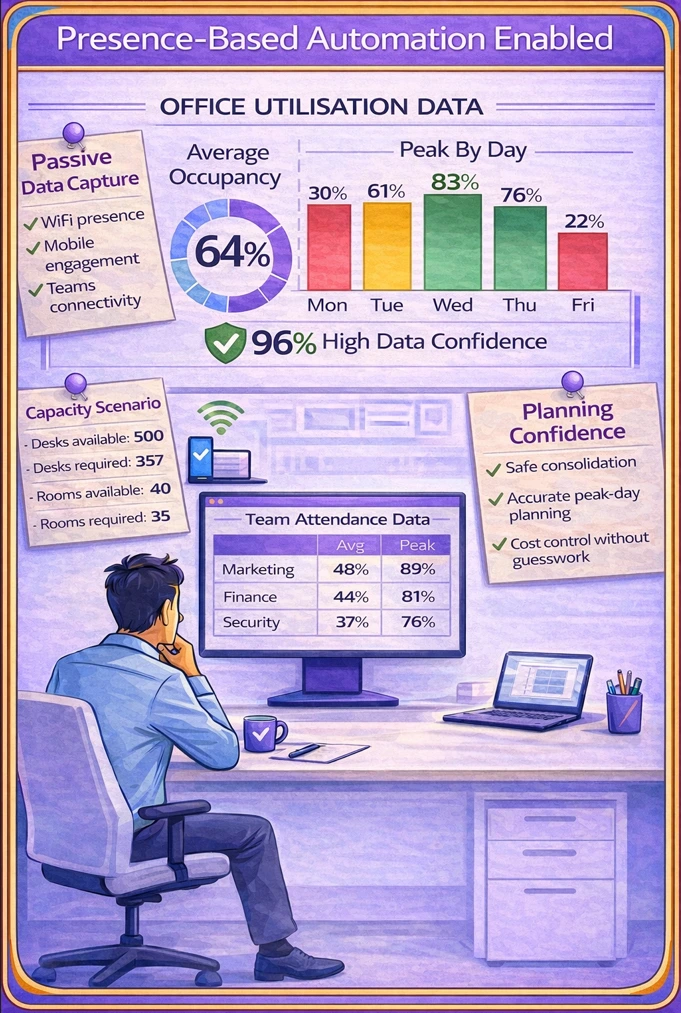
By reducing friction in how data is captured, organisations can build richer and more consistent workplace datasets.
This supports:
More accurate return to office and on-going planning
Better peak-day capacity modelling
Safer space consolidation decisions
Improved desk management strategy
Ongoing office space optimisation
Automation options to provision space when it’s needed, not when it isn’t
When office utilisation data reflects actual behaviour rather than imperfect booking habits, planning becomes more confident.
Facilities teams can shift from defending numbers to leading strategic conversations.
Return to office planning is not just about attendance targets.
It is about aligning policy, desk management and workplace optimisation with trusted, reliable data.
The organisations that navigate this phase successfully will not simply set clearer policies.
They will ensure their office utilisation data is accurate enough to make those policies work, and to adapt automatically as user behaviour evolves.
Enabling Accurate Office Utilisation Data with askAiB
At askAiB, we built our platform around a simple principle:
Workplace data should be accurate, low-friction and commercially useful – and acting on the data should be easy.
Return to office planning and desk management only work when office utilisation data reflects what is actually happening inside the building - not just what was booked in advance.
That is why askAiB combines:
Intelligent desk management and room booking
Presence-based automation using mobile and laptop connectivity
Passive data capture through WiFi and Teams integration
Clean, structured utilisation reporting designed for estate optimisation
Automation of space assignment based on real data
Instead of relying on manual check-ins or expensive layers of hardware, we focus on reducing friction for users while improving data quality for facilities teams.
The result is not just better reporting.
It is greater confidence in:
Space consolidation decisions
Peak-day planning
Estate cost control
Long-term office space optimisation strategy